
In this article, we introduce 19 online B2B contact lists providers, from which marketers can buy email list promptly.
When looking to buy B2B contact lists, it's important to choose reputable and reliable sellers. Some of the best B2B contact list sellers offer accurate and up-to-date data, comply with data protection regulations, and provide targeted lists based on your industry and criteria. Research and read reviews about sellers to ensure their legitimacy and the quality of their lists.
This page helps you to find a substitution for manual email searching to save time and costs, improve email reputation, and reduce bounce rates.

What Is B2B Contact Lists Database?
The B2B contact lists database is a source of essential information for B2B companies, including email addresses, phone numbers, websites, social media profiles, and other data you can utilize to communicate with buyers and sellers directly and quickly. If you want to buy email lists or other leads contacts, they can benefit you.
Getting up-to-date, quality, and far-reaching B2B contact lists help you connect with new prospects briskly, boost your sales funnels, and grow your company.
Only some contact list sellers will let you buy the correct and reliable contact data for your email marketing campaigns. Hence, you must choose the best B2B lead generation services and companies that bring their users the most accurate and quality results.
The purposes of the B2B contact lists building services include
- Enriching your data
- Generating potential leads
- Creating B2B contact lists
- Saving marketers’ time
- Reducing marketing costs
What Are the Top B2B Contact Lists Sellers to Buy Email Lists?
Let’s learn more about the top B2B contact lists providers to buy email lists from them in 2023.
CUFinder
CUFinder is a famous and experienced B2B contact lists vendor, which is perfect to buy email list from it.
The emails of over 180 million companies and employees are recorded in the CUFinder email database.

Some of the benefits of CUFinder lead generation are as follows:
- Advanced email finder
- Free bulk email verifier
- Phone finder engine
- Over 25 data enrichment tools
- Company & person search
- Recruitment engine
- Professor & university search
- A record of +262M firms’ data
- A record of +180M emails
- A record of +350M phone numbers
- Over 98% actual accuracy
- High speed & easy to use
- Seamless CRM integration
- Advanced filtering system
- No duplicated data
- Affordable prices
- Monthly free trials
- Both firms’ & individuals’ data
- Bulk contact lookup
- Coverage in +200 countries
- No need for manual data entry
- Monthly database update
- 24/7 real customer support
- No auto-renewal

It is worth mentioning that the CUFinder B2B lead generation platform doesn’t automatically renew your plan without your permission. It is one of the crucial issues that the users of many lead generation tools complain about.
To buy email lists from CUFinder, all you need is to follow the simple steps below.
After signing up on the CUFinder website, enter the dashboard and click “Prospect Engine” at the top.

Sing up process needs only your name and email. You can complete it in 1 minute.
You see two options. Click “Company Search.”
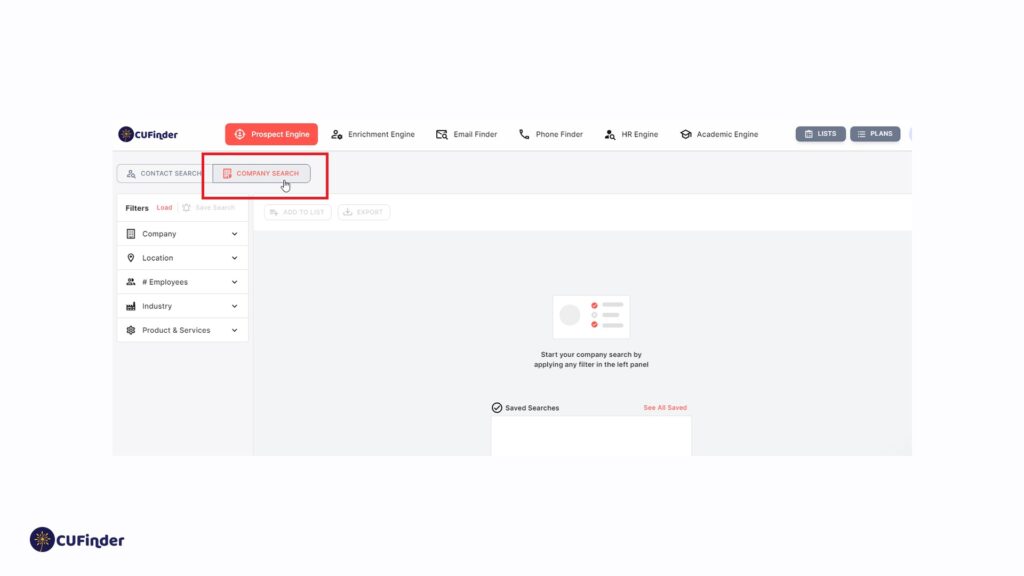
Some filters are demonstrated on the left side. Selecting your preferred search criteria to narrow down the results is recommended.
The more filters you select, the more targeted results you will achieve.
The list of filters includes
- Company
- Location
- Number of Employees
- Industry
- Products & Services


As you can see below, I selected “Industry” and “Location.” The first one is “Building Materials.” The latter is “USA.”

The list of all companies active in the building material industry located in the USA is demonstrated instantly.

You can click any company in the list to see its full report and get all its email addresses.
The following image is a sample company report. Click “Access Email” at the top right.

The list of all five email addresses associated with this company is demonstrated. CUFinder finds all the emails that a company has, unlike most other services that provide only one email address.

In addition to verified email addresses, you can receive more contact data containing the company’s phone numbers, website, LinkedIn, and other social media profiles, addresses, locations, etc.
Other data, such as the company’s industry, employee count, its website’s SEO data, list of products/services, and the data of the employees working in this company, are provided. You can see them in the pictures below.


Uplead
Uplead is a famous B2B contact lists provider with +108 million contacts of companies and a 95% data accuracy rate. Uplead is the preferred email finder for many marketers worldwide to buy email lists.
Uplead has provided some filters, such as industry, location, revenue, title, etc. The user should select any of the search criteria he wants. Then, Uplead shows the relevant companies in real-time.
Uplead streamlines lead delivery to CRM, outreach tool, or CSV without manual data entry.

Uplead has over 50 search criteria! Some users like the massive number of filters, but it can be confusing for others.
Lusha
Lusha is another service perfect for B2B prospect list building. By filtering your request, Lusha can provide targeted leads for you.
You can benefit from Lusha by buying email lists of prospects, old friends, colleagues, or any other person you wish.

In addition to the email database, Lusha has a complete phone number database. Some other data, like the number of employees, revenue, domain, industry, etc., are provided by the Lusha B2B lead generation tool.
Effortlessly streamline your B2B marketing and prospect list building with Lusha. It significantly reduces the time spent. Instantly access a vast email database of leads through a simple and quick process.
Waalaxy
Waalaxy is a marketing website for finding B2B companies and B2B contact lists.

It has an online email database appropriate for buying email lists. LinkedIn prospecting and cold emailing are handled with Waalaxy fast.
You can connect with potential clients who may not accept your LinkedIn connection requests. LinkedIn is the most complete B2B database in the world. Waalaxy assists you in taking advantage of LinkedIn by retrieving the prospects’ emails to enrich CRM.
You don’t need any technical expertise. It is a seamless and automated process.
Seamless.AI
Seamless.AI provides the validated phone numbers and email addresses of prospects
It finds B2B contact lists for the users and enriches their data lists.
It supports CRM integration with Salesforce, Hubspot, Outreach, LinkedIn Sales Navigator, and SalesLoft. Moreover, it has a Chrome Extension and offers 50 free searches for quality checking.

You can build lists of 1,000, 10,000, or even 100,000 contacts with Seamless.AI in a short time. Select your desired search criteria and get the data of leads and companies.
Forget manual prospect list building and substitute the manual way with Seamless.AI
Hunter.io
As your comprehensive email database, Hunter is a quality choice for email marketing. It helps you identify and establish connections with individuals crucial to your business’s success via their emails.

Hunter.io offers a robust email discovery solution, specializing in sourcing individuals’ and companies’ email addresses. It enables seamless outreach to key prospects. The input is a company’s domain or name, and the output is the company’s email.
Moreover, Hunter.io has an email verifier, ensuring the accuracy and validity of obtained email addresses.
Whether you want to connect with specific individuals or target entire companies, Hunter.io equips you with the tools to streamline your email marketing campaigns.
SalesIntel
B2B marketing teams can use SlaesIntel to clean their leads’ database and find new potential customers with their firmographic data and company news for their products or services.
SalesIntel provides companies’ and individuals’ email addresses in real-time to improve email sender scores and opening rates and decrease bounce rates.

This contact management and automation service is another way to save time. Instead of spending a long time finding leads manually, you can use SalesIntel.
SalesIntel can export your obtained emails to CRMs and CSV files. It has Chrome Extension and free trials for performance check-ups.
RocketReach
RocketReach provides B2B contact lists of potential customers for salespersons. It allows you to search 700 million profiles and 35 million companies by location, industry, and many more filters.

It has API and supports CRM integration. You can test RocketReach free trial before purchasing.
Engage directly with key decision-makers by using RocketReach’s collection of email addresses and phone numbers.
In the past digital marketers had to check many websites to find new prospects and gather their leads. This time-consuming process has been removed recently.
Automatic B2B contact list sellers are the best substitution for manual contact search, saving marketers time and energy and enabling them to focus on other vital parts of their job.
Voila Norbert
Voila Norbert offers an email finder and email verifier. B2B marketing can be performed faster and easier with the help of Voila Norbert.

It has an API, various CRM integrations, single and bulk search capabilities, and 50 free searches.
Via its bulk email enrichment, you can quickly check the accuracy of long email lists.
SignalHire
SignalHire provides B2B contact lists for users in real-time. Recruiters, sales experts, and marketers can instantly access up-to-date and verified emails, including both company and professional emails. Emails are found by a filtering system and by some search criteria like location, position, or name.

In SignalHire, emails are sourced in real-time, and before revealing any contact, they undergo verification through third-party tools. Bulk email lookup is possible in SignalHire B2B lead generation platform.
LinkedIn Sales Navigator
Another B2B contact list provider is LinkedIn’s Sales Navigator. It empowers you to explore the platform for prospect list building. Email marketing campaigns can make the most of LinkedIn and quickly buy email lists and phone numbers.
It has various capabilities:
- Lead and company search with pinpoint precision
- +40 search criteria to identify suitable leads & accounts
- CRM integration to add key contacts directly to CRM
- Finding past customers, colleagues, and classmates

However, limitations exist. It cannot confirm if your targeted lead is currently active on LinkedIn. Many LinkedIn accounts were created years ago, and it’s been a long since their owner didn’t check their profile. Hence, his email and contacts have not been updated since long ago.
Furthermore, response times on LinkedIn may be sluggish. Nevertheless, it remains a valuable B2B lead generation tool adaptable to budgets of all sizes.
People Data Labs
People Data Labs provides B2B contact lists of companies and their employees at scale. Marketers looking for leads’ emails can utilize this B2B lead generation tool.
Prospect list building and email marketing are tedious if marketers do it manually. People Data Labs has a global database of detailed company and individual profiles.

You can obtain current details of companies, including email addresses, phone numbers, social media accounts, employment and education history, and geographical locations.
Wiza
LinkedIn prospecting and scraping are possible with Wiza. It helps users export leads from LinkedIn with accurate emails, phone numbers, and other contacts.

Moreover, Wiza has a bulk email checker with which users can verify email addresses to avoid bounces and low email sender scores.
The user can export up to 2,500 leads at once from any LinkedIn Sales Navigator search query or saved list. It allows users to send their contacts to CRMs such as Hubspot, Salesforce, Pipedrive, etc.

RightHello
RightHello is a provider of B2B contact lists of potential customers. It has 50+ custom filters and 10+ different search methods. Prospecting and email automation tools help RightHello users to save time.

RighHello has a databank with the information of over 5 million companies. It guarantees 90% email deliverability.
ZoomInfo
One of the old B2B lead generation companies is ZoomInfo.
ZoomInfo has an advanced company and lead search. Based on many filters, It helps the user narrow the search and get the most relevant data.

Some marketing campaigns can’t afford ZoomInfo services. We recommend they use CUFinder, which provides high-quality B2B marketing services at affordable prices.
ZoomInfo has various services and features, but they made the website seem confusing, especially for newcomers.
Aeroleads
Aeroleads is another email finder and verifier that can help B2B companies and email marketing campaigns enrich their email databases and avoid low email deliverability. It can provide the emails and phone numbers of leads.

There are various ways available in Aeroleads to find emails. It can find the emails based on the following inputs and strategies:
- Filtering systems
- Employee’s full name and company name
- LinkedIn URLs
- LinkedIn Chrome Extension
Anymail Finder
The impact of bounce rates on email server scores is well-recognized for email marketing campaigns.
Anymail Finder has an online email database that prioritizes the discovery of validated email addresses. It guarantees bounce-free email communication.

It can find the emails of companies based on their names or domains. It provides the individuals’ emails by simultaneously searching the persons’ names and their companies’ domains or names.
Coresignal
Coresignal is a seller of B2B contact lists to marketers and data analysts. It is an automatic tool to put email lists and details of companies and people.

Coresignal provides
- Professional network data
- Firmographics data
- Employee data
- Job posting data
Coresignal has organized and cleaned data from 20 different sources, categorizing it into eight distinct data types. Its contacts and email database encompass crucial information about prospects and potential buyers of your products or services.
It supports various APIs you can see in the image below.
Kaspr.io
Kaspr has a LinkedIn Google Chrome Extension to extract large amounts of companies and individuals’ emails, phone numbers, and other data. It is an advanced tool for improving sales and the recruitment process.

LinkedIn was created to connect recruiters with job seekers. However, today, it is the most prominent business platform in the world, helping marketers and salespersons to find customers.
Whether you are looking for prospects or job seekers, Kaspr can help you. You can access bulk information and send the obtained data to your other apps and CRMs by Kaspr.
LeadMine
LeadMine is a lead generation software designed to identify your ideal customers and retrieve their email addresses with an impressive accuracy rate of 95%.

Marketers can find leads by location, industry, revenue, position, company name, and employee count in LeadMine.
It has a 120 million work email database. It has 10 million companies and 50 million individuals in its database.
LeadMine has an email finder and verifier to discover leads’ emails and check their accuracy in real-time. It checks the emails’ syntax and MX record of the domain and ping the mail server for email deliverability.
It has a Chrome Extension and free trials for newcomers.
Conclusion
Manual lead generation and email finding are labor-intensive and time-consuming, distracting marketers from other vital tasks.
How much time do you need to find 1000 potential buyers for your new product? Is it easy to find the emails of people and companies at scale? Are the emails you found on the web valid, or may they lead to low deliverability?
This article introduced 19 famous automatic tools to buy email list and B2B contact lists in bulk and rapidly. Say goodbye to the sluggish speed of your email marketing campaign!
FAQ
- How do I find B2B contacts? CUFinder is a lead generation tool for finding B2B contacts on a large scale. CUFinder has an advanced filtering system, which helps users find the most relevant and targeted leads with their verified contacts.
- What is a B2B specific list? A B2B specific list is the data and contacts of a group of targeted B2B leads gathered in a list by CUFinder. This list is prepared according to the search criteria that the user had selected, so it is based on the needs and preferences of the users.
- How do I get a B2B email list? CUFinder provides B2B email lists for the email marketing teams in real-time. The emails of companies and individuals in any part of the world are recorded in the CUFinder email database, and the user can access them via an advanced filtering system.
- What is the best B2B email finder tool? CUFinder is the best B2B email finder in the market, as it can find the correct emails of both companies and their employees on a large scale and in real-time.
Comments